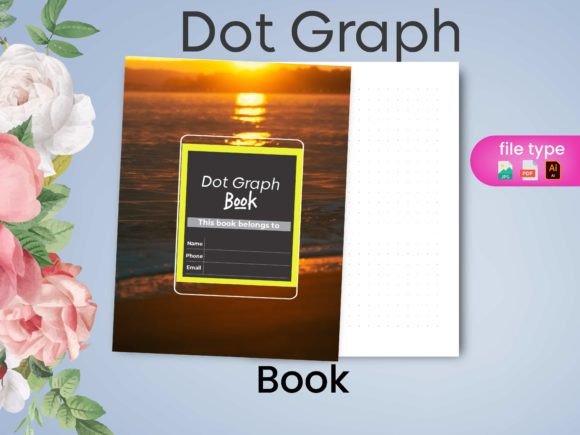
The Unseen Power of the Dot Grid: Beyond Traditional Notebooks
In the world of paper-based organization, creativity, and planning, there exists a quiet revolution. While lined notebooks offer structure and blank pages promise freedom, a hybrid tool has emerged, marrying the precision of grids with the flexibility of empty space. This tool is dot graph paper. When harnessed through modern digital publishing platforms, it transforms into something even more powerful: Editable Dot Graph Paper KDP Interiors. This isn't merely a page layout; it's a customizable framework for thought, design, and productivity, accessible to anyone from professional architects to weekend hobbyists.
Decoding the Features: What Makes It Different?
The technical specifications of an Editable Dot Graph Paper KDP Interior—like the common offerings of 8.5" x 11", 6" x 9", or 8" x 10" sizes, 120 pages, and bleed for printing—are important for practical use. But the core innovation lies in three key elements: the dot grid itself, the editable source file, and the multi-format readiness. The dot grid provides subtle guidance without the imposing lines of a traditional graph, allowing for straight lines when needed and freeform sketching when desired. The inclusion of an editable source file, often in a format like AI, is a game-changer. It means the template is not a static product but a starting point. Users can adjust dot spacing, add marginal guides, incorporate headers or footers, or even blend the dot grid with other page styles within the same interior.
A Canvas for Disparate Minds
Consider the applications. An urban planner might use the dot grid to sketch neighborhood layouts, using the dots to scale approximate distances. A teacher could employ it to create custom worksheets for geometry, where students connect dots to form shapes. A novelist might find the faint dots perfect for outlining chapter arcs or character relationships in a visual mind map, unobstructed by heavy lines. The real-world relevance is vast because the tool adapts to the user's intent, not the other way around. The high-quality, print-ready PDF ensures that these personal or professional creations transition seamlessly from digital design to physical notebook, tested for platforms like Amazon KDP.
Advantages Over Conventional Paper Templates
Why choose an editable dot graph paper interior over a pre-printed notebook bought from a store? The first advantage is personalization. The editable source file allows for tailoring. You can change dot color to a subtle grey for less visual interference or a bold black for more guidance. You can add a personalized title page or section dividers. The second advantage is scalability. For creators and small business owners, this is a product template. They can adjust it, brand it, and upload it to print-on-demand services, creating a unique product without graphic design expertise. The third is efficiency. Having a ready-to-upload package with multiple formats (PDF, AI, JPEG) streamlines the publishing process, eliminating the need to test margins, bleed, or page counts manually.
Key Considerations for Potential Users
While the benefits are significant, effective use requires some understanding. The term "editable" presupposes access to and basic familiarity with design software capable of handling the source file format, like Adobe Illustrator or similar. The choice of page size—whether the standard US letter (8.5" x 11"), the compact 6" x 9", or the 8" x 10"—should align with the intended final use. A larger size suits technical drawing; a smaller one might be ideal for a portable bullet journal. Furthermore, the minimal design is a feature, but it's a blank slate. Its usefulness is directly proportional to the user's input—it's a framework waiting for content.
Integrating Editable Dot Graph Paper into Creative Workflows
For a digital creator, the workflow might begin with downloading the Editable Dot Graph Paper KDP Interiors package. They open the AI file, change the cover text to reflect their brand, perhaps add a light watermark on every page, and export a new print-ready PDF. For an educator, the workflow could involve using the dots as anchor points to create custom tracing sheets for students or precise charts for scientific data logging. In a corporate setting, a team might use adapted versions of the interior for standardized project sketching, ensuring everyone's notes maintain a consistent, legible structure. The dot grid's versatility means it can be inserted into almost any workflow that benefits from visual organization.
Observations from various fields show a trend towards structured flexibility. Bullet journaling, a popular method for personal productivity, heavily favors dot grid pages because they allow for the creation of calendars, trackers, and lists without being confined to rigid columns. The rise of print-on-demand has democratized publishing, making tools like these KDP interiors invaluable for entrepreneurs who wish to offer niche, specialized notebooks—for guitar tablature writing, quilting pattern design, or even language learning vocabulary trees—without massive upfront costs.
The Principle of Guided Freedom
The underlying strength of editable dot graph paper is a principle we might call "guided freedom." The dots offer a suggestion, a potential anchor, but do not command. This is psychologically different from a lined page, which dictates horizontal writing, or a blank page, which can feel dauntingly empty. It supports both order and chaos, which is why its appeal spans such a broad audience: from the researcher needing orderly diagrams to the hobbyist sketching whimsical ideas. The editable aspect amplifies this, allowing the user to set the degree of guidance themselves before they even begin to use the page.
From Digital File to Physical Tool: The Final Output
The journey of an Editable Dot Graph Paper KDP Interior culminates in a tangible object. Once customized and uploaded through a platform like Amazon KDP, it becomes a physical notebook available to others. This bridges the digital creation space and the analog use space. A consumer purchasing such a notebook isn't just buying paper; they're buying a thoughtfully designed structure intended to enhance their specific activities. Whether it's for architectural drafting, creative writing, business planning, or academic note-taking, the final product is a testament to the utility of adaptable design. The inclusion of a tested, error-free PDF ensures that this transition from screen to print maintains integrity, with proper bleed and margins so that the dot grid sits perfectly on every page of the bound book.
In essence, Editable Dot Graph Paper KDP Interiors represent a shift from static stationery to dynamic template. They acknowledge that while the need for paper persists in many lives and professions, the one-size-fits-all notebook often falls short. By providing a minimal, editable, and professionally prepared foundation, they empower creators to build the exact paper tool they or their customers need. This isn't just about selling a downloadable file; it's about enabling a more organized, creative, and efficient approach to the countless tasks that still begin and end with a pen and a page. The dot grid is the silent facilitator, and the editable interior is the key to unlocking its full, personalized potential.