The Ultimate Guide to Extreme Sudoku: Mastering Logic and Enhancing Your Mind
For many, Sudoku is a familiar pastime found in newspapers and puzzle books. But beneath its simple grid of numbers lies a profound challenge of logic and pattern recognition. When the difficulty level escalates to "Extreme," it becomes more than just a game—it transforms into a rigorous mental workout, a test of patience, and a gateway to enhanced cognitive abilities. This article explores the world of Extreme Sudoku, delving into its mechanics, its significance, and how collections like Vol-4 250 EXTREME Sudoku KDP Interiors provide both a formidable challenge and a valuable tool for anyone seeking to sharpen their mind.
What is Sudoku? A Foundation of Logic
Sudoku is a logic-based, combinatorial number-placement puzzle. In its classic and most popular form, the objective is to fill a 9×9 grid with digits so that each column, each row, and each of the nine 3×3 subgrids (often called "boxes" or "regions") contain all of the digits from 1 to 9. The puzzle begins with some cells pre-filled with "given" numbers. The solver's task is to use pure logic to deduce the correct numbers for the empty cells. There is no mathematics involved; no arithmetic is required. The solution depends entirely on logical deduction and the elimination of possibilities.
A common misunderstanding is that Sudoku requires mathematical skill or guesswork. In truth, a properly constructed Sudoku puzzle has a single, logically derivable solution. Guesswork or "trial and error" is not only inefficient but often leads to contradictions. The true art of Sudoku lies in identifying patterns and applying logical rules sequentially to narrow down possibilities until every cell is confidently filled.
The Jump to Extreme Difficulty
Sudoku puzzles are typically graded by difficulty: Easy, Medium, Hard, and Extreme (sometimes called Evil or Diabolical). An Extreme Sudoku puzzle is characterized by a specific arrangement of the given numbers. Often, the "givens" are fewer or placed in such a pattern that the logical path to the solution is long, complex, and requires the application of advanced solving techniques.
While easy puzzles might rely on simple "single-candidate" or "single-position" rules, Extreme puzzles demand a deeper understanding. Solvers must employ strategies like:
- X-Wing and Swordfish: Pattern-based elimination techniques that look for alignments across rows and columns.
- XY-Chain: A chaining logic that connects multiple cells to eliminate candidates.
- Forcing Chains: Exploring the consequences of placing a particular number to reveal contradictions or confirmations.
These techniques move beyond basic spotting and require the solver to hold multiple possibilities in mind while tracing logical implications across the entire grid. The "Extreme" label signifies not just harder puzzles, but puzzles that engage higher-order logical thinking.
The Significance and Benefits of Extreme Sudoku Practice
Engaging regularly with Extreme Sudoku puzzles offers benefits that extend far beyond mere entertainment. Its relevance in modern life is tied directly to cognitive health and skill development.
A Tool for Cognitive Enhancement
Solving these puzzles is a full-brain exercise. It strengthens:
- Concentration and Focus: Maintaining attention on a single, complex task for extended periods.
- Logical Reasoning and Deductive Skills: Building the ability to draw necessary conclusions from given information—a skill valuable in problem-solving across professions.
- Pattern Recognition: Training the mind to see shapes and relationships in data, a key component in fields from data analysis to creative design.
- Memory and Working Memory: Keeping track of eliminated candidates and potential patterns across the grid.
- Patience and Persistence: Overcoming the frustration of a stalled puzzle by systematically exploring new logical avenues.
In an age of constant digital distraction, dedicating time to a deep, analog-style logic puzzle like Extreme Sudoku can provide a valuable counterbalance, training the mind in sustained, focused thought.
Practical Relevance in Daily Life and Work
The skills honed by Sudoku are not confined to the puzzle grid. Logical deduction is foundational to programming, debugging code, legal analysis, scientific research, and strategic planning. Pattern recognition is crucial for understanding trends in business data, learning new languages, or even mastering a musical instrument. The patience developed through tackling an Extreme puzzle can improve one's approach to complex projects at work or personal goals. For students, these puzzles offer a fun way to develop critical thinking skills that complement academic learning.
Introducing Vol-4 250 EXTREME Sudoku KDP Interiors
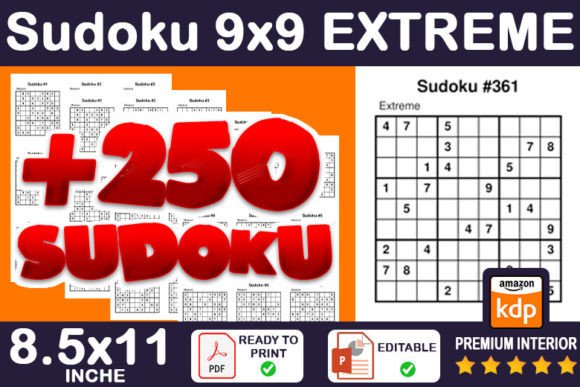
For the dedicated solver or the aspiring expert, a curated collection of high-quality puzzles is essential. Vol-4 250 EXTREME Sudoku KDP Interiors represents such a resource. It is a digital product designed specifically to provide a massive volume of top-tier challenges.
This package typically contains 252 Extreme Sudoku puzzles complete with solutions, formatted for versatility and high quality. Key features include:
- Standard 9×9 Sudoku puzzle grids.
- A total of 252 puzzles accompanied by solutions, ensuring you can always check your work or learn from the correct logic path.
- A layout of 9 Sudoku puzzles per page, optimized for printing and use.
- A consistent difficulty level: Extreme.
- 57 pages formatted for 8.5 x 11 inches (US Letter size), a standard print dimension.
- Very high-quality design, ensuring clear, readable puzzles.
Flexibility and Customization for Every User
One of the standout aspects of such a digital interior package is its adaptability. It is designed as a template or source material that you can customize to fit your specific needs. Whether you are a puzzle enthusiast creating a personal workbook, an educator assembling materials, or a publisher using Kindle Direct Publishing (KDP) to create a book, this format offers immense flexibility.
YOU CAN:
- Create KDP interiors in several standard book sizes (8.5×11, 6×9, etc.).
- Change the font style to match your design preferences.
- Adjust the scale of the puzzles or pages.
- Change colors, perhaps to create a themed book or to aid visual solving.
- Add more Sudoku puzzles from other sources to expand the collection.
- Insert images, logos, or instructional graphics.
- Modify the layout to include notes, tips, or difficulty indicators.
This makes it not just a static puzzle book, but a dynamic project. It empowers you to create the exact Sudoku experience you want, whether for personal use, gifting, or commercial publication.
How to Approach and Conquer Extreme Sudoku
Facing a book of 252 Extreme puzzles might seem daunting. Here is a natural, step-by-step approach to build your skills and enjoyment.
Start with a Systematic Method
Even at the Extreme level, the foundation is basic logic. Begin every puzzle by scanning for obvious "singles." Then, move on to more advanced techniques methodically. Keep a clean grid—many solvers use pencil marks (small numbers in the corners of cells) to note possible candidates. This "candidate marking" is crucial for Extreme puzzles as it visually maps the remaining possibilities and reveals hidden patterns.
Learn the Advanced Techniques
Don't be discouraged if a puzzle stalls. Use the provided solutions as a learning tool. When stuck, peek at the next step in the solution (not the full answer) to see what technique was applied. Research terms like "X-Wing" or "XY-Chain" online. There are numerous tutorials and videos that explain these strategies clearly. Understanding these concepts turns an impossible grid into a solvable, logical sequence.
Integrate Puzzle Solving into Your Routine
Treat your Sudoku practice like a mental gym session. Regular, shorter sessions are more effective than occasional long, frustrating ones. Perhaps solve one Extreme puzzle per day as a morning brain stimulant or an evening unwind activity. The cumulative effect of regular practice will dramatically improve your speed and skill, making the puzzles in Vol-4 progressively more approachable.
The Broader Understanding: Sudoku in Context
Sudoku, especially at its Extreme level, fits into a long tradition of logic puzzles and games that humanity has used to entertain and educate itself. From chess to crosswords, these activities provide structured environments for cognitive challenge. Sudoku's pure logic basis makes it uniquely accessible—it requires no specialized knowledge, only the willingness to think.
In our technology-driven world, such analog puzzles offer a tangible, screen-free hobby that nonetheless develops skills highly relevant to digital professions. They remind us that deep thinking, patience, and systematic problem-solving are timeless virtues. A collection like Vol-4 250 EXTREME Sudoku KDP Interiors provides a gateway to this rewarding practice, offering both a ready-made challenge and the creative freedom to tailor that challenge to your life.
Whether you seek to push your logical abilities to their limit, create a unique puzzle book, or simply find a satisfying and beneficial daily ritual, the world of Extreme Sudoku awaits. Dive into the grid, embrace the logic, and enjoy the profound satisfaction of placing that final number, knowing it was arrived at not by chance, but by the clear, powerful force of your own deduction.