Combining Houseplant Care with Interior Design Planning: A Unique Planner Approach
For individuals who manage a Kindle Direct Publishing (KDP) business while also nurturing a passion for home aesthetics and greenery, organization tools often feel segmented. A finance planner sits separately from a creative journal, and a plant care log rarely intersects with home improvement notes. The Houseplant Tracker-KDP Interiors planner emerges as a distinct product by intentionally bridging these typically separate domains. It is a daily planner and notebook specifically designed for KDP entrepreneurs who are also houseplant enthusiasts and home design aficionados. Its core distinction lies in its hybrid function: it serves as a practical business tool for managing a KDP enterprise while simultaneously providing structured sections for tracking plant health and planning interior design projects.
Understanding the Integrated Format and Its Practical Value
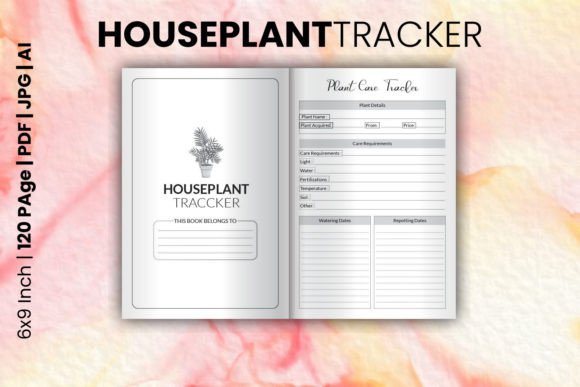
The planner is structured as a 120-page, letter-size (6" x 9") book, offered in editable and print-ready AI, PNG, and PDF files. This format is a practical consideration for the KDP seller themselves; it's a product ready for upload and printing without requiring additional design work, featuring no bleed for straightforward production. But beyond its production-ready specs, its internal layout is what defines its utility. Rather than being a generic daily planner, it allocates space for three interconnected areas: daily KDP business tasks (like marketing, publishing schedules, and sales tracking), detailed houseplant care logs (for watering, fertilizing, and growth observations), and notes for interior design ideas that might influence one's living or workspace environment.
This integration acknowledges a realistic overlap in interests and time management for its target audience. For example, a user might note a KDP task to "design new cover art" on Monday, log a "fertilized Monstera" entry on Tuesday, and jot down "research ergonomic desk chairs for office" on Wednesday—all within the same, cohesive notebook. This avoids the friction of switching between multiple specialized journals and can provide unexpected creative synergies, where the calm, nurturing aspect of plant care might inspire a design choice for a book cover or a workspace layout.
Comparing Integrated vs. Specialized Planner Approaches
When evaluating organization tools, users often face a choice between highly specialized products and more generalized, all-in-one notebooks. A specialized houseplant care journal would offer deep, scientific tracking for dozens of plants, possibly with moisture sensors or photography logs. A dedicated KDP business planner might focus intensely on niche keywords, Amazon SEO tactics, and royalty calculation templates. Conversely, a generic bullet journal offers total flexibility but requires the user to build all structures from scratch, which consumes time.
The Houseplant Tracker-KDP Interiors planner occupies a middle ground. It provides predefined structure for its three core areas, offering a balance between guidance and flexibility. Its strength is in serving the multifaceted individual whose hobbies and business are not siloed. However, a tradeoff exists: it is not the optimal tool for someone seeking exhaustive, single-focus tracking. A professional botanist or a KDP business analyst requiring complex data sheets would find its sections too limited. Its best-fit situation is for the hybrid enthusiast-entrepreneur who values cohesion and simplicity over deep, isolated specialization.
Key Decision Factors for Potential Users
Choosing this planner over other options depends on several personal and practical factors. The primary consideration is the actual overlap of your activities. If your engagement with houseplants is minimal (a single resilient succulent) and your interior design projects are non-existent, then the dedicated KDP business sections might be sufficient, but you'd be carrying unused pages. Alternatively, if your KDP business is a minor hobby and your primary focus is urban gardening, a different tool would be more efficient.
A second factor is your preference for digital versus physical planning. The product provides editable files (AI, PDF), which is a significant benefit for those who prefer to customize digitally before printing or who operate a hybrid digital-physical system. However, it is fundamentally designed as a physical notebook. If you rely entirely on digital apps like Notion or specialized plant care software, this product's value lies more in its potential as a printable KDP product for your store rather than as your personal tool.
Lastly, the 6" x 9" no-bleed letter size is a standard, economical format for KDP printing. For the user-as-seller, this means low production complexity and cost. For the user-as-consumer, it means a portable, manageable book size. Compare this with larger, more lavish planners that include bleeds for full-color artwork; this planner adopts a pragmatic, functional aesthetic aligned with its purpose.
When This Planner Is the Right Choice and When to Look Elsewhere
The Houseplant Tracker-KDP Interiors planner is likely the right choice if you are actively managing a KDP business (even at a small scale) and you simultaneously maintain several houseplants while regularly considering or executing home decor changes. It streamlines your week by consolidating these threads into one reviewable place. It is also a strong option if you are a KDP seller looking to stock a niche planner that serves a growing community of plant-loving entrepreneurs, as it represents a ready-to-sell product in a specific cross-interest category.
You may need another option if your needs are overwhelmingly skewed toward one domain. If KDP is your full-time, data-intensive business, a planner dedicated to Amazon publishing metrics and strategies would offer more actionable insights. Similarly, if you own a vast collection of rare plants requiring precise humidity and light logging, a botanist's logbook or a digital app with reminder functions would serve you better. The integrated nature of this planner means it makes tradeoffs in depth to achieve breadth, which is perfect for some but inadequate for others.
Exploring Strengths and Realistic Limitations
A notable strength of this planner concept is its reflection of a contemporary lifestyle where personal passions and side businesses frequently coexist. It validates that these interests are not distractions from work but can be complementary parts of a holistic routine. The inclusion of interior design sections also taps into the reality that our workspaces—often where KDP business is conducted—impact productivity and well-being, and that houseplants are a key element of those spaces.
From a practical standpoint, the provision of fully editable source files (AI and PDF) is a major advantage for sellers with basic graphic design skills, allowing for color scheme changes, font adjustments, or minor layout tweaks before publishing under their own KDP account. This flexibility is often missing in pre-made, locked PDF templates.
A limitation, inherent to its design, is page count. 120 pages divides roughly into three sections, meaning approximately 40 pages per focus area. For a daily planner used over a quarter or half a year, this necessitates concise entries. It is not a limitless journal. Furthermore, the "no bleed" design means graphics and colors are confined to a safe margin area, resulting in a clean but potentially less visually dramatic interior compared to full-bleed artistic planners. This is a functional, not a luxury, product.
Making an Informed Selection Based on Your Workflow
To decide if this integrated tool fits your needs, conduct a simple audit of your current tracking methods. Are you using a separate notebook for business notes, an app for plant reminders, and a Pinterest board for interior ideas? Does the dispersal of these logs cause friction or forgotten tasks? The Houseplant Tracker-KDP Interiors planner proposes a centralized solution. Conversely, if your existing separated systems are highly efficient and you value their independent depth, consolidation might actually reduce functionality.
Consider also your long-term goals. If you aim to grow your KDP business significantly, having integrated plant care notes might become less relevant over time, and a migration to a more professional business management system could be inevitable. In that case, this planner could serve as a useful bridge during a transitional phase where both interests hold equal weight.
Ultimately, the product serves a specific intersection of hobbies and commerce. Its value is clear for those within that intersection, offering a practical, printable, and thoughtful space to manage multiple facets of a creative, entrepreneurial life. For those squarely in one camp or whose interests lie in different combinations (like KDP and fitness, for instance), exploring other specialized or customizable resources would be a more aligned path. The key is matching the tool's integrated structure to your actual, integrated daily realities.